You may benefit from a daily probiotic and here’s why.
Taking the right probiotic blend may support and enhance wellness. Here’s what probiotics are, how they can help balance certain conditions, tips for safe use, and more.
Probiotics are popular supplements often taken to enhance and promote healthier digestion but provide other benefits as well.
Adding a broad spectrum probiotic containing multiple strains to your daily regimen may be helpful, and here’s why.
Here are some of the beneficial properties of probiotics noted from a study by Shi et al.
- Probiotic supplements may assist in the treatment of bowel diseases by enhancing immunity.
- Probiotics may reduce cholesterol levels, improve atopic eczema, rejuvenate the skin, assist in wound healing and scar formation, and fortify the skin’s barrier functions.
- Probiotics inhibit the growth of periodontal and cariogenic pathogens and are useful for dental cavity prophylaxis/treatment and other periodontal conditions including halitosis (bad breath).
- Probiotics have been useful for anxiety and depression via modulation of the nervous system connection between the brain and gut (GI tract). Probiotics were noted to improve mood, lessen anxiety, and reduce the stress response in those with irritable bowel syndrome (IBS) and chronic fatigue syndrome. I’ll explain the brain-gut connection shortly.
A quality probiotic blend can provide the microbiota to help replenish the balance caused by dysbiosis within the intestinal biome (gut microbiome), tone down the brain-gut axis response, support digestion and immunity, and assist in the creation of vitamins and amino acids (the building blocks of bodily proteins).
That’s a lot of information to digest, and here’s what it means.
What’s the brain-gut axis?

Grenham et al. explains the brain-gut axis well. Here’s a quick summary.
The brain-gut axis is the connection between the ENS or enteric nervous system (associated with the intestines/gastrointestinal or GI tract ), and the CNS or central nervous system (associated with the brain and spinal cord).
The ENS is responsible for intestinal movement, secretions, and immunological defense. It relays messages to the brain and spinal cord through the vagus and pelvic nerves, and sympathetic pathways.
The vagal nerve’s “gut” response to stress (mental, emotional, or physical) can cause changes throughout the body causing symptoms such as nausea, sweating, dizziness, and tinnitus to name a few. Probiotics may help balance and regulate this response.
Signals from the brain are relayed to the ENS and can influence gut activity. Studies support that an unhealthy or imbalanced gut may affect both mood and behavior.
Probiotics have been noted to support a healthy gut microbiome and sooth dysbiosis.

What is the gut microbiome, and why is having a balanced one so important?
The gut microbiome is composed of a vast number of different species of microorganisms (a.k.a. microbes or microbiota).
The microorganisms of the microbiome play an important role in bodily functions. In a healthy person, they are mostly located in the small and large intestines.
Microbiota keep us healthy in many ways by playing an active role in immunity, digestion, and the creation of vitamins and amino acids (the building blocks of bodily proteins) to name a few.
When balanced, they are considered non-pathogenic (not related to or causing disease).
Overgrowth or deficiency of microbiota creates an imbalance known as dysbiosis.
What is dysbiosis?
Simply put, it’s an imbalance in the type and or/numbers of microbiota in the gut microbiome and is associated with many health related conditions. Dysbiosis can affect wellness on many levels.
WebMD notes that dysbiosis creates a greater likelihood of having the conditions listed below.
- Diabetes
- Cancer
- Obesity
- Disorders of the CNS (central nervous system)
- IBD or inflammatory bowel disease
- IBS or irritable bowel syndrome
- Cardiovascular issues
What causes dysbiosis?

- Improper diets, excess sugar consumption, and poor nutrition can cause dysbiosis. Diets containing excess sugar can lead to a candida (yeast) overgrowth, sugar cravings, and other undesirable symptoms.
- Antibiotics or other medications that target both harmful and helpful microorganisms alike can cause imbalance.
- Infectious diseases can disrupt the healthy balance.
- Chemo and radiation therapy affecting both targeted as well as other healthy cells and organisms can cause dysbiosis.
How does dysbiosis affect health?
WebMD notes some of the mild to more severe effects of dysbiosis.
- Digestive problems such as cramps, diarrhea, constipation, gas and bloating, heartburn/acid reflux, and food intolerances.
- Mood and behavior effects such as anxiety, depression, changes in concentration, and ADHD.
- Skin related symptoms such as rashes, psoriasis, and acne.
- Vaginal and rectal itching or infection may be present.
- Problems urinating may be a symptom of dysbiosis.
- Joint ache and inflammation, and chronic fatigue may be present.
Are there situations in which probiotics may not be recommended?

Although probiotics have been noted to replenish and help reestablish balance within the microbiome and have other helpful effects, they may not always be recommended.
Here are a few examples and things to consider.
In complicated situations or in the presence of existing conditions, it’s best to consult with a qualified healthcare professional.
It’s important to note that in the presence of certain conditions (severe immunosuppression or immunocompromise, melaena, etc.), probiotic therapy is most likely contraindicated (not recommended). Introducing even normally healthy strains in these cases may challenge the body’s defenses. Click on the link above for more details on this and other informative articles on probiotic use during pregnancy, lactation, and for infants, children, and the elderly. It’s a good read when you have the time.
Remember that probiotics are live microbes so if surgery is in your future, it’s important to consult your doctor before beginning or continuing them.
It’s recommended to consult a health care provider prior to using probiotics at any age. If pregnant, breastfeeding, very young or old, experiencing troublesome or concerning symptoms of any kind, have existing conditions, and/or taking medications, please seek the guidance of a qualified healthcare professional to ensure safe use and best effect.
Are there conflicting opinions on the use of probiotic supplements?

We know what they can do, how they may help, and when they are likely contraindicated, but it’s important to note that in the world of conflicting opinions and schools of thought, probiotic use and effectiveness is no exception.
Some note that probiotics help with inflammation, allergies, symptoms of IBS (irritable bowel syndrome), dyspepsia, diarrhea, and constipation. Others disagree.
In a Harvard T.H. Chan School of Public Health article, Dr. Walker notes that probiotic supplementation in a healthy adult or older child without imbalance or antibiotic therapy may not produce a noticeable effect.
He further notes that probiotic supplements may be helpful in the following situations.
- Probiotics can be effective for those of extreme age (very young or old) who have less “robust” or hardy microbes by fortifying the colonization within the microbiome.
- Probiotics may be helpful for diarrhea resulting from exposure to pathogens (the microscopic organisms that can cause illness).
- Probiotics may be helpful for replenishing the normal intestinal bacteria following a course of antibiotics.
This study also contains a lot of interesting information on how diet affects the microbiome and more.
GoodRX notes that probiotics can help maintain the intestinal biome during a course of antibiotics. The American Gastroenterological Association also supports the use of probiotics in adults and children receiving antibiotic therapy.
A quality probiotic blend with multiple strains can help the body function more efficiently. It can re-establish balance within the gut microbiome and may help balance and regulate the brain-gut vagal response.
Understanding the strains most effective for your specific concern(s) before choosing a reputable product, consulting with a qualified provider as needed, paying attention to the body’s response, and fine tuning unhealthy dietary and lifestyle practices, paves the road toward improved health and wellness.
Below are some helpful tips for choosing a probiotic supplement including an explanation of CFU’s (colony forming units), strains, safe use, how to find the best match for your specific needs, and a product review.
What’s good to know when searching for a probiotic supplement.

Taking a probiotic blend can be helpful, but probiotic products differ in the number, quality, and type of strains they contain and their abilities.
Here’s some helpful information.
First of all, probiotics are categorized as supplements which aren’t regulated by the US Food and Drug Administration (FDA). Since there are no mandatory requirements, the manufacturer isn’t required to list production and quality standards.
Quality can and will vary. Not all probiotics are created equal. Some may contain inactive strains and/or contain concentrations less than what’s noted on the package label.
It’s best to buy high quality products from reputable companies using GMP (good manufacturing practice).
Different strains of probiotics have specific effects and benefits. Different products may contain 1 or many strains. Mindbodygreen recommends choosing a blend with strains having the ability to sooth your specific concerns.
According to Flore, it’s important to be aware of the CFU content of a probiotic.
A CFU (colony forming unit) is the number of live cells per serving (i.e. 1 or 2 capsules, etc.) noted on the product label.
Why are CFUs important?
The total CFU is important because different ages and health concerns require different CFUs. In addition, some individuals may be more sensitive to the effects of probiotics. Taking too high of a CFU for your constitution may cause bloating and other undesirable symptoms.
A product CFU of 5 billion or more is often recommended.
Here’s more helpful information.
- Probiotic needs vary according to age, overall health, and condition. Many can benefit but not everyone absolutely needs to take probiotics daily.
- Some products are not recommended for young children. Consulting with a pediatrician is highly recommended to rule out underlying conditions including food allergies and sensitivities and for choosing the best age appropriate product.
- Read the product labels carefully. Many are best taken on an empty stomach.
- When taking probiotics during a course of antibiotics, many health care providers recommend taking the probiotic 1 to 2 hours after the oral antibiotic. There isn’t a lot of research on whether a probiotic taken with an antibiotic would be less effective, but it makes sense to separate them. Spacing them out even further can still be effective.
- The amount of capsules taken per day may vary depending upon your individual constitution and tolerance.
- Taking the least amount that produces improvement is best. Start with a lower dose then increase slowly over time if needed. It’s important to pay attention to your body’s tolerance and response.
- Advancing too quickly may cause side effects such as bloating, discomfort, gas, and diarrhea which makes it difficult to determine if the blend is helping or aggravating the concern.
- If one daily seems too much as determined by your body’s response, adjust accordingly (every other day or every 3 days etc.) or try another high quality probiotic with a lower CFU. If it doesn’t seem enough, slowly increase the dose as indicated.
- Using a blend with multiple strains may promote a healthier balance.
- Some report a noticeable difference within a few days. Others may take longer.
- Some probiotic products require refrigeration. Others don’t and are shelf stable. I’ve used both finding them equally effective.
- In the presence of certain conditions, probiotics may not be recommended. It’s important to be aware of this to avoid potentially ill effects.
- Please remember to take only as directed per product label unless advised otherwise by a qualified healthcare professional. Megadosing is a risky practice.
- Just another quick reminder to please seek the advice of a qualified health care provider prior to using probiotics especially if pregnant, breastfeeding, very young or old, experiencing troublesome or concerning symptoms, have existing conditions, scheduled for surgery, and/or taking medications.
A daily probiotic became a part of my routine years ago as a supportive treatment coupled with diet and lifestyle changes to help manage my celiac and IBS associated digestive concerns. The combination was a success and a daily low dose probiotic continues to keep things running smoothly.
I’ve recommended the blend I use to friends and family members for various uncomplicated digestive concerns and to support the gut microbiome during and after a course of antibiotics. They noticed improvement and were pleased by the results.
Here’s a quick review of the blend I’ve been using for 15+ years as an example.
Primal Defense Ultra Probiotic product details and review.
Primal Defense Ultra Probiotic Blend is a product made by Garden of Life LLC, a Florida based certified B corporation.
This product contains 2 mg of iron (10% DV) , 13 strains, and 5 billion CFUs per 1 capsule. It’s not intended for children and is free of gluten, preservatives, and artificial colorings.
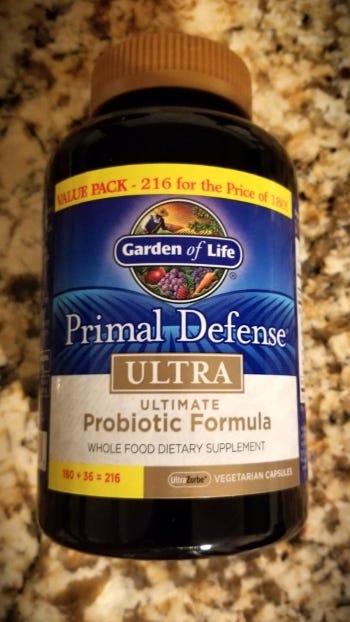
The adult serving size is 1 capsule once daily up to 1 capsule 3 times daily. Per label, they are best taken on an empty stomach, should be stored in a cool dry place, and kept out of the reach of children.
The capsules are reasonably priced and easy to swallow despite their larger size. There is no unpleasant or lingering aftertaste. This product doesn’t need refrigeration making it convenient when traveling.
I take one capsule nightly on an empty stomach for the best effect, and the 216 count bottle lasts about 7 months.
Where to purchase this product and cost.
I shop on-line for this product paying about $60.00 for the value pack (advertised as 216 capsules for the price of 180). It’s also available for purchase in 60, 90, 120, and 180 count sizes.
Vitacost usually has the best price with coupon codes and free shipping for orders totaling $49+ after applied discount(s).
This blend can also be purchased locally in natural/health food stores, select grocers, and some chain pharmacies. In store prices can vary widely, so it’s best to shop around.
If a probiotic is in your future, there are many quality products available. Whatever product you choose, please take the time to find the safest, most affordable, high quality product with the CFUs and strain combination best matching your specific needs and concerns.
I hope this information was helpful. Please share, link, and pass the word to others. If you have questions suggestions, or comments, please reach out. I would love to hear from you.
To receive future writings, please consider joining my email list.
Click here for more of my healthy product reviews.
For more articles on health and wellness, click here.
Wishing you continued health and wellness.

Kimberly I
Updated January 2024 by Kimberly Iacoponi
This information is for educational and reference purposes only. It is not approved or intended to diagnose, treat, cure, or prevent disease or illness, suggest a specific treatment, or to be used as the replacement for or substitution of treatment by a qualified medical professional. If you are experiencing troublesome or concerning symptoms please be evaluated. If you are taking medications, pregnant, or breastfeeding please seek the guidance of a qualified medical professional before starting supplements.
Any product mentioned, recommended, or reviewed is one I use, find effective, and don’t receive revenue from. If this changes, it will be noted.
Sources
Boyers, L. & Singh, M. (2023, February 17). A Guide To The Most Common Types Of Probiotics & What They Do. mindbodygreen. https://www.mindbodygreen.com/articles/guide-to-most-common-probiotic-strains-and-what-they-do
Brennan, D. (2022, December 6). What is Dysbiosis? WebMD. https://www.webmd.com/digestive-disorders/what-is-dysbiosis
Cassoobhoy, M. (medically reviewed). (2023, April 23). Inflammatory Bowel Disease: Symptoms and Treatment. WebMD. https://www.webmd.com/ibd-crohns-disease/inflammatory-bowel-syndrome
Flore (2020, December 10). CFU: What it is and How Much Do You Need. sun genomics. https://flore.com/blogs/learn/what-is-cfu-and-is-a-higher-cfu-probiotics-count-better
Grenham, S., Clarke, G., Cryan, J. F., & Dinan, T. G. (2011). Brain-gut-microbe communication in health and disease. Frontiers in physiology, 2, 94. https://www.ncbi.nlm.nih.gov/pmc/articles/PMC3232439/ https://doi.org/10.3389/fphys.2011.00094
Irritable Bowel Syndrome Resource Center. (n.d.). WebMD. https://www.webmd.com/ibs/default.htm
The Microbiome. (n.d.). Harvard T.H. Chan School of Public Health, The Nutrition Source https://www.hsph.harvard.edu/nutritionsource/microbiome/safe
Scott-Lutyens, J. (Updated 2023, July 21). Are Probiotics Safe to Take? Optibac Probiotics Learning Lab. https://www.optibacprobiotics.com/learning-lab/about/probiotics/are-probiotics-safe
Shi, L. H., Balakrishnan, K., Thiagarajah, K., Mohd Ismail, N. I., & Yin, O. S. (2016). Beneficial Properties of Probiotics. Tropical life sciences research, 27(2), 73–90. https://www.ncbi.nlm.nih.gov/pmc/articles/PMC5031164/ https://doi.org/10.21315/tlsr2016.27.2.6
 Eudaimonic Well-Being